


The Bitter Taste of Integration
by Pierandrea Villa
Overview
February 24, 2022
81′
Hleb Papou
Giuseppe Brigante, Emanuele Mochi, Hleb Papou
Clemart, Mact Productions, Rai Cinema, with the support of the Ministry of Culture and Regione Lazio
Luca Nervegna
Fabrizio Paterniti Martello, Fabrizio Franzini
Andrea Boccadoro
Germano Gentile, Maurizio Bousso, Ilir Jacellari, Giancarlo Porcacchia, Marco Falaguasta, Simona Senzacqua, Hedy Krissane, Ina Gjika, Antonio Veneziano
Fandango
Gallery
Poster


Trailer
Pressbook
Representation strategies, rhetorics and stereotypes
Narrative & characters


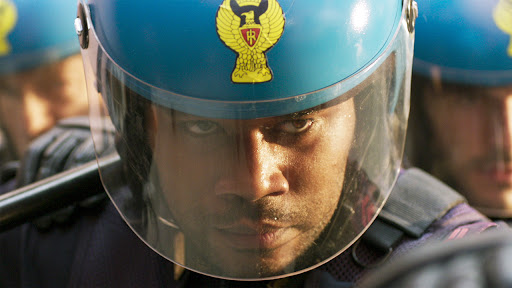
Daniel and Patrick are two brothers who are second-generation citizens of Cameroonian origin. The former is a riot police officer, while the latter is the head of the occupation committee of a building in Rome. Their stories converge dramatically when Daniel is compelled to participate in the forced eviction of the building. The film revolves around Daniel’s dilemma, torn between a desire for integration and the shame of betraying his origins and family. Through this narrative device, the film shows the identity issues faced by second-generation citizens. At the same time, Patrick’s story also exemplifies the social and economic difficulties faced by foreign citizens in Italy. While the film centres on the contrasting life choices of the two brothers, it consistently emphasises ambiguity, nuances, and overlap. This is evident from the very first scene of the film, in which we see foreign protesters clashing with a riot police squad. Immediately after the clash, the distinctness of the positions held by these two factions dissipates when Daniel removes his uniform helmet, revealing his appearance. However, the model of integration represented by Daniel’s character is by no means painless and rejects any assimilationist representation of diversity. This is particularly evident in the scene where he goes to pick up his brother at the police station without wearing his uniform, and the officers treat him like any other immigrant. Even in his own work environment, Daniel’s origins are constantly pointed out by his teammates, starting with the nickname they gave him: Ciobar: an Italian hot drink mixture of milk and chocolate, and, by extension, black and white. Moreover, while training at the police station, the agent provocateur frequently mentions his mother on the boat. However, Daniel’s family becomes the most important compromise that he is forced to accept: in order to keep his place in that environment, he must hide his relationship with Patrick and his mother and fabricate an alternative backstory. However, prior to a planned eviction operation – which is eventually deferred – he chooses to alert his family about the situation. The entire film moves towards the collapse of Daniel’s precarious balance, until his inevitable involvement in the eviction of the squatted building where his family lives. Throughout the film, Daniel becomes increasingly tired, violent, and less able to cope with the ambiguity of his situation. This drama unfolds in moments when the protagonist swings from one extreme to the other of his precarious balance, as exemplified in two specific scenes. The first, occurring when he is off duty, involves an attack on one of the squatters, met with racist slurs, during a visit to his mother;
The second incident, occurring while Daniel is on duty, involves his decision to charge during a far-right demonstration because he cannot tolerate the racist statements made by one of the demonstrators.
In terms of representing diversity, the film does not isolate the two protagonists. Instead, they are immersed in a pluralistic and fully multicultural community, a feature particularly evident in the sequences that explore Patrick’s background. Also in this case, the elements at play become evident as soon as the character is introduced during an occupation committee meeting. In this scene, the roll call effectively illustrates a model of coexistence among individuals from diverse ethnic and racial backgrounds, all bound by a precarious existence overshadowed by the threat of eviction. Moreover, Patrick’s own family life exemplifies the complexity and diversity of the Italian social structure, as it includes a second-generation black citizen – Patrick himself – an Albanian immigrant, and their son.
Stereotypes & strategies of inclusion
Divergence, convergence and isolation


The Legionnaire moves between opposing poles that attract and repel each other, depicting compromises between seemingly irreconcilable situations as well as the divergences and convergences of positions and subjective identities. The film’s dynamic, which permeates the entire narrative, is encapsulated in a particular scene in which the two brothers engage in a heated confrontation. Daniel joins his mother and brother in the building to inform them of their impending eviction the next day, suggesting that they leave the building and stay with him instead. At this point, Patrick confronts his brother, blaming him for his ambivalence. The resulting dialogue is a revealing moment in which the aspects that unite Patrick and Daniel and the distance that separates them emerge simultaneously. During the confrontation, Partick recalls their childhood spent in the squat, while the insults they hurl at each other highlight how their life choices have literally placed them on opposite sides of the fence. Furthermore, the constant allusion to a promise made by Daniel to his family highlights the precarious balance and ongoing compromise he faces between his roots and his challenging integration into society. The dialogue is particularly significant because it characterises a series of successive scenes, making the film a dark and disenchanted tale of integration. After confronting his brother, Daniel experiences a nightmare, where he breaks into the building and attacks both his brother and mother. In the subsequent scene, a phone call reveals that Daniel did not show up to work the following day.
This sequence of scenes exemplifies Daniel’s condition as a subject, showing a condition that, although apparently divided in dualistic terms, is in fact the result of a constant process of merging and integrating seemingly incompatible dimensions. Considering these aspects, the film’s conclusion reveals The Legionnaire as a bitter tale of integration. Daniel’s balance is ultimately broken when he is compelled to participate in the eviction of the building, despite yet another attempt to escape. During the operation, on the one hand, he is forced to personally arrest his brother Patrick, and on the other, his origins are revealed to his teammates and his superior. In this sense, The Legionaire shows two possible scenarios for integration: resistance and assimilation. While the former leads to difficulties in life and repression, the latter may demand even harsher conditions regarding the negotiation of the subject’s identity. Indeed, Daniel’s acceptance within his team hinges solely on his willingness to betray his origin.
The despising looks that Patrick and the team leader give Daniel at the end of the operation reveal the failure of his attempt to reconcile his two worlds. This opens up a scenario where, in a desperate bid to make these worlds coexist, the protagonist ultimately finds himself isolated
Conversations
Actors Maurizio Bousso and Germano Gentile, together with director Hleb Papou, present the film during the Rome Film Festival 2021 (Fred Film Radio, October 15, 2021).
The director retraces the creative process that led to the making of the film, addressing both the short film of the same name and the field research conducted together with the screenwriters (Tutta Scena1, February 23, 2022).
The director explains the reasons behind the choice of the film’s title and focuses on the need to portray second generations and the housing emergency, rejecting rhetoric (SpettacoloEu, March 8, 2022).
The director discusses the achievement at the Locarno Film Festival (August 2021).
The two protagonists describe their experience on set and their relationship with the characters (HotCorn, October 16, 2021).
“‘Il legionario’: to tell the truth, you have to get inside it.” In Rolling Stone, October 16, 2021. Interview with Hleb Papou by Luca Barnabé.
«I wanted to avoid lecturing people about reality with my finger pointed, as sometimes happens in certain arthouse films. I have no lessons to teach».
“Il legionario, Hleb Papou’s debut film, hits theatres”. In Fabrique du Cinéma, February 23, 2022. Luca Ottocento interviews Hleb Papou.
«It all started with an image that came to my mind several years ago: that of a black policeman, born and raised in Italy, wearing a riot police uniform».
“The urgency of the present”. In Filmidee, February 25, 2022. Interview with Hleb Papou by the editorial staff.
«I wanted to avoid clichés and worn-out topics. Mochi, Brigante and I wanted to tell a story about present-day Italy, going beyond stereotypes and trying to be as honest as possible».
“Hleb Papou and the excellent debut of his ‘Il legionario’. Interview with the young director”. In Taxi Drivers, October 16, 2021. Interview with Hleb Papou by Veronica Ranocchi.
«We felt a strong need, especially me, to tell this story going beyond stereotypes, pietism, rhetoric and do-goodism. We needed to shout out that this is the reality of Italy today».
“Hleb Papou: ‘I made ‘Il Legionario’ for the audience, not for an algorithm’”. In Cinecittà News, November 7, 2022. Interview with Hleb Papou by Carlo D’acquisto.
«The film has its own political value, but it is not ideological or propagandistic. It is one thing to present a problem from a political perspective, and quite another to simply label some as villains and others as saints».
“Germano Gentile: I am a black actor beyond stereotypes”. In Ansa, February 23, 2022. Interview with Germano Gentile by Francesca Pierleoni.
«I now feel that Daniel is part of me. We have had very different life experiences, but I understand that kind of comradeship, having experienced it myself playing football for over twenty years. Back in the suburbs, there were few black kids, and we grew up hearing certain jokes».
Business strategies and communication rhetorics
Strategies
The film was produced with the support of Mic – Directorate-General for Cinema and Audiovisuals and the Lazio Region, as part of the Lazio Cinema International programme. The title is also co-financed by the European Union.
As stated by the director in the press kit, the film stems from the need to portray, on the one hand, the living conditions of immigrants and second-generation citizens and, on the other, the housing emergency that is affecting Italy. However, the main premise in The Legionnaire – a black policeman serving in one of the toughest police departments – came to the director in 2014. From a purely production point of view, the film was shot in just nineteen days during the pandemic and set inside a real squat in Via Santa Croce in Gerusalemme. This location gained attention in 2019, when the Pope’s almoner removed the seals from the power generator, an event that was later depicted in a scene in the film. In order to gain a realistic picture of the housing emergency and further his research, with the aim of producing an authentic account, the director lived in the building for an indefinite period before starting filming. Indeed, some of the 480 real residents of the building appear in the film, such as the person who plays Valencia. The director also collaborated with Sabina Guzzanti, who appears in a cameo role in the film and had previously addressed the issue of the housing emergency in the documentary Spin Time che fatica la democrazia!. In particular, the actress and director was contacted “to reconstruct the atmosphere of solidarity that arises when the electricity is cut off in the building” (La rivista del Cinematografo, 15 October 2021).
The portrayal of the mobile police unit characters also drew on the expertise of a consultant, whose insights contributed to the creation of Aquila, the head of the unit in the film.
The Legionnaire is moreover based on the director’s graduation short film of the same name, which deals with some of the same issues, but was unable to contain all the information the director had gathered during pre-production. The production company Clemart became interested in the project after seeing the short film, recognising “the potential of Papou’s direction and the power of the story” (Taxi Drivers, 4 March 2022) and immediately saw the possibility of a successful festival run.
Communication rhetorics
The film’s promotional strategy primarily highlighted its achievements at both national and international film festivals, particularly emphasizing the prestigious Pardo award for Best Director in the Cineasti del Presente competition at the Locarno Film Festival. In the days leading up to the film’s release, interviews were published both in the press and on the official festival channels, highlighting the film’s themes. These discussions paid significant attention to the director’s approach, which rejects dichotomy and dualism on one hand, and paternalistic, sugar-coated views of reality on the other. The discussion around the film has also centered on its authenticity, which arises not only from the preliminary research conducted by the director and screenwriters but also from the casting of Germano Gentile and Maurizio Bousso. The two actors have personal stories that in some ways mirror those of the characters they play: the former was born in Brazil and adopted by Italian parents, while the latter was born and raised in Rome by an Ethiopian mother and Senegalese father.
Conversations
“‘Il legionario’: interview with Clemart producers Gabriella Buontempo and Massimo Martino”. In Taxi Drivers, March 4, 2022. Interview by Veronica Ranocchi with Gabriella Buontempo and Massimo Martino.
«We choose our productions depending on what moves us. Then, by chance, ultimately there is always a strong social message behind them. But fundamentally there is never a common thread».
Circulation and audience responses
Circulation patterns
The film was distributed in Italy by Fandango, which also handled foreign sales. Distribution abroad was handled by HBO Europe (in Bosnia-Herzegovina, Bulgaria, Croatia, Moldova, Montenegro, Poland, the Czech Republic, Romania, Serbia, Slovakia, Slovenia, and Hungary) and Telelatino (Canada).
The film has been widely screened at national and international festivals, providing it major exposure. However, it was notably absent from thematic festivals, with the exception of the Afrobrix Film Festival in Brescia and the Terra di Tutti Film Festival in Bologna. Concerning its theatrical release, the film was available in Italy for three weeks across 22 cinemas, a period slightly above average for a directorial debuts, possibly because of the prestige achieved following the Pardo award for Best Director in the Cineasti del Presente competition at the Locarno Film Festival. Furthermore, in some arthouse theatres such as the Cineteca di Bologna, the title remained available for up to three weeks. Nevertheless, box office takings remained modest, at approximately €28,000. Of course, given the release period, it is necessary to account for the troubled period that cinemas experienced due to the measures put in place to contain the coronavirus pandemic, which were still in force at the time.
The film also experienced an above-average distribution in the secondary television market, not in terms of the number of screenings, which were limited, but in terms of the time slots during which it was shown. The Legionnaire was broadcast twice in prime time, on Rai Movie and Rai 5 respectively. The film has also been widely distributed internationally, particularly in the Balkans and Eastern Europe. Concerning streaming platforms, the film is available on 18 online catalogues distributed across 11 European countries. Although the film’s visibility is above average in terms of both distribution and broadcasting, it remains limited and does not reflect its success at festivals. This condition, common to many debut films, is particularly striking for a feature that not only secured one of the most prestigious awards on the European festival circuit, but since it conforms to a genre that would be suitable for wide audience distribution. This scenario once again reveals a context, that of Italy, in which the success of a film’s distribution appears to be exclusively tied to factors such as the author’s reputation or the cast’s popularity.
Festivals
- Un’Estate al Cinema Panorama 2025
- Festival du Cinema Italien de Montelimar Panorama 2023
- Quinzaine du Cinema Italien a Chambery Panorama 2023
- Premio Apoxiomeno Panorama 2023
- Premio Cinema Giovane e Festival delle Opere Prime Concorso 2023
- 70 anni di passione e inclusione per il cinema Panorama 2023
- Il Cinema Indimenticabile Panorama 2023
- Premio Sergio Amidei Agora’ 2023
- Arena Cinematografica Monterosa Panorama 2023
- Barriera a Cielo Aperto Panorama 2023
- Nuovo Cinema Italia Panorama 2023
- Casilino Sky Park Panorama 2023
- Festival de Cinema Italiano a San Jose’ Panorama 2023
- Italian Film Festival (ITAFF) Panorama 2023
- Saldi! Bimbi Belli – Esordi nel Cinema Italiano Panorama 2022
- Afrobrix Film Festival Evento Speciale 2022
- Cinecittà Film Festival Concorso 2022
- Festival Cinema e Musica Panorama 2022
- Festival del Cinema Europeo di Lecce Finalista Premio Mario Verdone 2022
- L’Italia Che Non Si Vede Panorama 2022
- Popoli e Religioni – Terni Film Festival Concorso 2022
- SIFF’s Cinema Italian Style Panorama 2022
- Verso Sud Panorama 2022
- Cinema Made in Italy – Athens Panorama 2022
- CinemaItaliaOggi Balcani Panorama 2022
- Rassegna del Piccolo Cineclub Tirreno di Follonica Panorama 2022
- Terra di Tutti Film Festival Domenica Matinee 2022
- Cinema! Italia! Panorama 2022
- Italian Cinema Week South Africa Panorama 2022
- MoliseCinema Paesi in Lungo. Concorso Lungometraggi 2022
- Settimana del Cinema Italiano – Sudafrica Panorama 2022
- Arena San Biagio Panorama 2022
- Bimbi Belli Concorso 2022
- Piazze di Cinema Accadde Domani 2022
- Premio Monty Banks Concorso 2022
- OPEN ROADS: New Italian Cinema Panorama 2022
- Sotto le Stelle del Cinema Premio Cipputi 2022 – Menzione Speciale 2022
- Bellaria Film Festival Concorso Casa Rossa 2022
- Integrazione Film Festival Film d’Apertura 2022
- BAFF – Busto Arsizio Film Festival Made in Italy – Scuole 2022
- Festival Cinema du Monde de Sherbrooke Feature Film 2022
- Moviemov – Italian Film Festival Manila Italian Showcase 2022
- Semana de Cine Italiano Buenos Aires Panorama 2022
- Festival du Cinema Contemporain Italien de Tours – Viva il Cinema Concorso 2022
- Festival International du Film de Mons Les Premieres 2022
- Univercine Cinema Italien Competition 2022
- Frammenti di Festival Panorama 2022
- Moviemov – Italian Film Festival Italian Showcase 2022
- Cinenido – Visioni Disturbate Panorama 2022
- De Rome a Paris Panorama 2022
- Pune International Film Festival World Competition Films 2022
- Sudestival Concorso Lungometraggi 2022
- Corto Dorico Concorso Opere Prime Salto in Lungo 2021
- Festival del Cinema di Porretta Terme – Porretta Cinema Nomination Premio Elio Petri 2021
- Mostra de Cinema Italià de Barcelona Panorama 2021
- Salto in Lungo Panorama 2021
- Sottodiciotto Film Festival & Campus Esordio italiano 2021
- Appuntamento con il Cinema Italiano a Istanbul Panorama 2021
- CineMaOltre Palladium Film Festival Panorama 2021
- Istanbul’da Italyan Sinemasi Festivali Panorama 2021
- MittelCinemaFest Panorama 2021
- Rencontres du Cinema Italien a Toulouse Competition 2021
- Roma3FF Panorama 2021
- Visioni Italiane – Officinema Evento Speciale 2021
- Alice nella Città Concorso Panorama Italia 2021
- Festival du Film Italien de Villerupt Competition 2021
- Incontri del Cinema d’Essai – Premio FICE Panorama 2021
- Annecy Cinema Italien Concorso 2021
- Costa Iblea Film Festival Premio Rosebud Opera Prima /Carrubo d’Oro 2021
- Hamburg International Film Festival Veto! 2021
- Locarno Film Festival – Festival Internazionale del Film di Locarno Concorso Cineasti del Presente 2021
- Cinema Made in Italy Copenaghen Panorama 2021
- Festival de Cinema Europeen de Les Arcs Industry Village Work in Progress 2020.
Awards
2023 Premio Cinema Giovane e Festival delle Opere Prime (festival):
Premio Giorgio Fanara Migliore Attore (Germano Gentile)
Premio per Opera Preferita dagli Studenti
2022 Asti International Film Festival (festival):
Premio Giuria Giovani
2022 Cinecittà Film Festival (festival):
Premio Migliore Film
2022 Bimbi Belli (festival):
Premio Migliore Attore (Germano Gentile)
2022 Premio Cipputi (concorso):
Menzione speciale
2022 BAFF – Busto Arsizio Film Festival (festival):
Premio BAFF – Made in Italy Scuole
2022 Univercine Cinema Italien (festival):
Prix du Public
2022 Sudestival (festival):
Menzione Speciale della Giuria
2021 Annecy Cinema Italien (festival):
Premio Art Cinema – CICAE
2021 Costa Iblea Film Festival (festival):
Premio Rosebud Opera Prima “Carrubo d’Oro”
2021 Locarno Film Festival – Festival Internazionale del Film di Locarno (festival):
Pardo alla Regia – Cineasti del Presente (Hleb Papou)
Reception
Given its success at national and international festivals – particularly as recipient of the Pardo for Best Director in the Cineasti del Presente competition at the Locarno Film Festival – the film attracted the attention of a vast array of critics. Overall, critics praised the film’s realistic and raw approach, along with the director’s and other authors’ commitment to deliver a story that is free from rhetoric. Critics have also warmly praised the film’s main themes, their relevance and the necessity of adopting an original and unbiased perspective on them, as the film does.
Concerning the actors, while many appreciated the performances of Germano Gentile and Maurizio Bousso, others described them as still immature, but promising. Papou’s direction also divided critics. On the one hand, his solidity, original vision, and ability to shoot action scenes, even with a limited budget, were praised. Conversely, there was ample criticism suggesting that Papou’s direction appeared somewhat unresolved, particularly in terms of guiding the actors and handling the dialogues.
The audience response was decidedly more lukewarm than the critical and festival acclaim; the film has a rating of 5.9/10 on IMDB and scores 3,3/5 on Letterbox, while there are no audience ratings on MyMovies, a phenomenon that reflects the film’s poor circulation in theatres and on the secondary market in Italy.
Italian and foreign press
Italian Press
Gabriele Niola, “Il legionario is the Italian crime film to see this year”. Wired, February 24, 2022.
«And in fact, Il legionario is a step forward both formally and in terms of content. Because it overcomes the usual us/them dichotomy without denying it, it overcomes the conventional way of addressing and imagining it. It no longer focuses on choosing a side or on hoping for a specific outcome. Instead, it is interested in the conflict itself, the reasons behind it, and, especially, the mistakes made by both sides».
Davide Turrini, “Il Legionario, when the ‘black’ policeman uses his truncheon to clear out the (also) ‘white’ squatters. Hleb Papou’s short-circuited film”, Il Fatto Quotidiano, February 22, 2022.
«Among the ruthless, notoriously “fascist” police officers, there is one “black” officer who is even an example to his comrades for his cunning in inflicting pain while remaining within the limits of what is permitted. Among the many demonstrators, there are many “white” (and Italian) people».
Gabriele Niola, “Il legionario, a film debut to keep an eye on”, GQ, February 24, 2022.
«It is a crime story that tells one of the fundamental stories of our times, that of how the country is changing and the contrasts that this change entails. It achieves this not through dramatic imagery but through action».
Federico Pontiggia, “With ‘Il legionario’, racial conflict is now inside our homes”, Il Fatto Quotidiano, February 26, 2022.
«A liberation from the us-them opposition that has all the attributes of poetic and political freedom, that is to say, of self-representation».
Foreign Press
John Bleasdale, “The Legionnaire examines racial tensions amongst Roman riot police”, BFI, August 13, 2021.
«Papou and his fellow screenwriters Giuseppe Brigante and Emanuele Mochi have created a rich and complicated picture of the incomplete integration of Italy. They have balanced a social realist melodrama with thriller aspects that might sit less comfortably if not for two magnificent performances by Gentile and Bousso».