


Attempts at Inclusion and Narrative Reassurances through the Limits of Adaptation
by Greta Delpanno
Overview
Rai Uno
2022
1 season; 12 episodes
remake of This is Us (2016–2022, NBC)
Luca Ribuoli
Dan Fogelman
Sandro Petraglia, Flaminia Gressi, Michela Straniero
Cattleya in collaboration with Rai Fiction and 20th Television
Fabrizio La Palombara
Pietro Morana
Nada, Andrea Farri
Lino Guanciale, Aurora Ruffino, Dario Aita, Claudia Marsicano, Livio Kone, Angela Ciaburri, Leonardo Lidi, Flavio Furno, Timothy Martin, Liliana Fiorelli
Rai Uno, Rai Play
Gallery
Poster




Audio description
Audio description of the TV series Noi, available on RaiPlay Sound
Pressbook

Representation strategies, rhetorics and stereotypes
Narrative & characters
Noi is the Italian adaptation of the U.S. series This Is Us, produced by Rai Fiction and Cattleya and broadcast on Rai Uno in spring 2022. The decision to localize a highly successful international format gave rise to a narrative that preserves the ensemble and multi-layered structure of the original while reinterpreting it within the Italian context. The story follows Pietro and Rebecca Peirò (played by Lino Guanciale and Aurora Ruffino) and their three children Claudio, Cate, and Daniele, alternating different time frames and bringing past, present, and future into dialogue through an interweaving that combines family melodrama and social reflection.
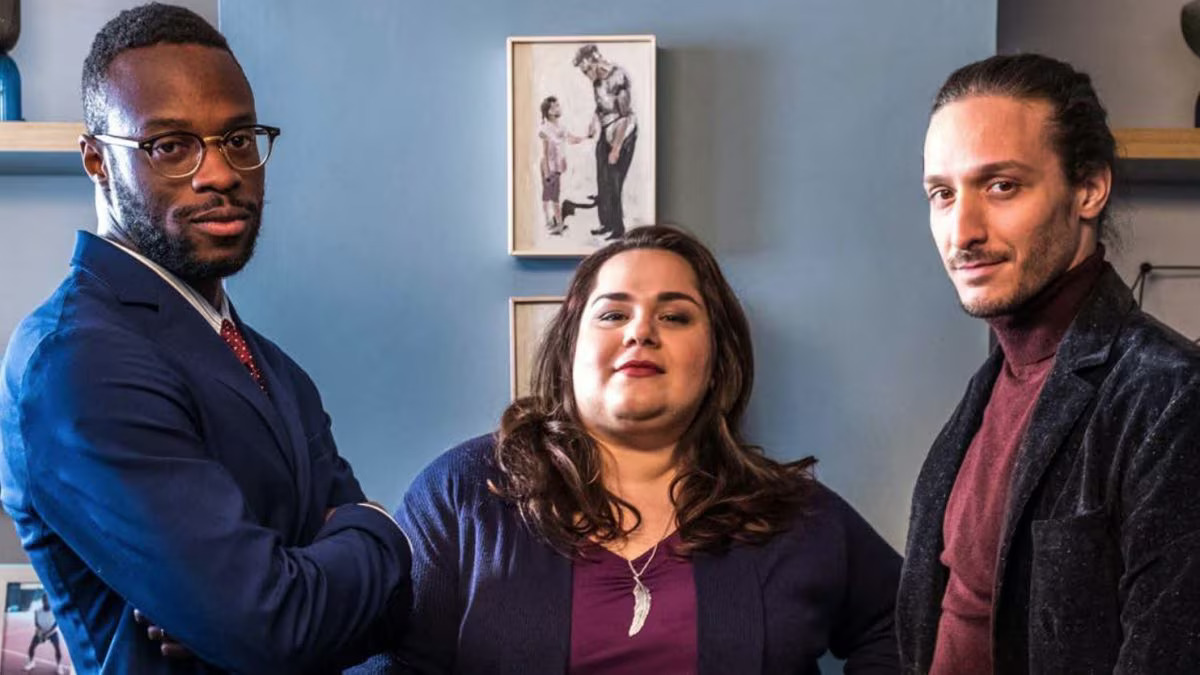
The seriality of Noi is grounded in an emotional and relational register, in which the characters are constructed as vectors of broader identity themes. Claudio embodies the path of an aspiring actor struggling with the frustrations of a stalled career; Cate addresses issues of corporeality and insecurities related to weight; Daniele, adopted and Black, becomes the center of the strongest tensions in terms of representation, highlighting the difficulties of growing up as the son of a white family in Italy. His trajectory in particular makes explicit the intercultural dimension of the narrative: Daniele is not only a “different” character but one who embodies the confrontation between belonging, race, and recognition, constantly traversed by the gaze of others and by the need for legitimacy.
The parental couple, Pietro and Rebecca, instead represents affective continuity and the value core of the series. Through them, Noi constructs a model of family that is at once traditional and open: traditional in the centrality of the domestic unit, open in its ability to welcome a Black adopted son, thus bringing into the mainstream narrative a representational dynamic still little explored in Italian fiction.
Another central aspect concerns the dimension of the body and social visibility. The character of Cate becomes a privileged point of observation on female insecurities and on the stigmatization of the nonconforming body. Her story, between the search for self-esteem and the desire for recognition, intertwines with that of Daniele, in a parallelism that shows how discrimination and vulnerability can take different yet complementary forms.
From a stylistic perspective, the series employs the time-shift structure as a device to emphasize the continuity of wounds and desires across generations. This mechanism, borrowed from the original format, makes it possible to highlight how past choices and traumas continue to influence the characters in the present, situating the family narrative within a broader historical and cultural framework.Noi thus experiments with a hybridization between family drama and discourse on inclusion, without ever departing from the strongly mainstream emotional register. On the one hand, the series seeks to normalize the presence of a Black adopted son and a daughter who experiences discrimination linked to the body; on the other, it constructs these trajectories primarily as tools for generating empathy and recognition in the audience. In this way, the representational strategies aim more at integrating diversity within a reassuring framework of family unity than at thematizing identity conflicts in a critical manner.
Stereotypes & strategies of inclusion
Noi addresses the theme of inclusion along two main axes: Daniele’s racial and adoptive identity and Cate’s nonconforming body. Both characters experience daily the weight of others’ gaze and of social expectations, in a narrative that alternates moments of empowerment with scenes that reproduce already consolidated narrative patterns. The sequences analyzed here highlight how the series attempts to thematize conflicts related to diversity, while always maintaining a melodramatic and family-oriented register.
“Instead I see them” – Daniele between adoption, discrimination, and the relationship with his biological father (Ep. 3)

One of the central axes of Daniele’s story is the reunion with his biological father, who had abandoned him at birth as a former drug addict from a working-class background. After their reconciliation, the father temporarily moves in with Daniele and his family in Milan. In the third episode, the man argues with the building’s concierge who, not knowing who he is, discriminates against him because of his skin color. Daniele intervenes, and later explains to his father: “You think that since I was raised by white people, maybe I don’t see certain things. Instead I see them.” The sentence encapsulates the ambivalence of his position: raised in a white, affluent family, he has learned not always to react to provocations, but he remains fully aware of the racism surrounding him.
The scene acquires further significance because it intertwines with the storyline of the biological father, who carries with him a condition of marginality and illness (he dies of cancer in the eleventh episode), creating a contrast between two divergent social trajectories: that of the integrated son and that of the excluded father. In the past, through flashbacks, the series had already shown how Pietro and Rebecca faced the difficulties of raising a Black son, observing his need to identify with other children like him and to construct cultural references not provided by the family environment. In this sense, the encounter with the biological father and the dialogue with the concierge make explicit the tension between the reassuring integration offered by adoption and the awareness of persisting discrimination.
“Walking around with your head held high” – support and sibling conflicts (Ep. 5 and Ep. 7)

The issue of recognition emerges forcefully in episode 7, when coach Connor encourages Daniele by reminding him that others before him had shown “people like us that we could walk around with our heads held high.” Immediately afterward, in one of the most powerful symbolic images of the series, Pietro performs push-ups with Daniele on his shoulders, literally supporting him: a gesture that represents the affective bond but also the desire to transmit strength and stability to a son whose identity remains fragile in the eyes of others.
However, Daniele’s path is also marked by conflict, as shown in his fight with Claudio in episode 5. The two brothers brawl in the street, revealing tensions accumulated during childhood: Claudio, athletic and “popular,” has always felt that his parents were more focused on Daniele’s integration and on Cate’s weight problems, leaving him in the background; Daniele, for his part, has always longed to be recognized by his brother. The clash is resolved in a paradoxical way, with Claudio telling the gathered crowd: “Don’t worry, he’s my brother.” For Daniele, it is the first time he receives explicit confirmation of that bond, to the point of ironically commenting that Claudio had to beat up “a Black guy in the middle of the street” in order to recognize him.
The scene thus thematizes both the internal conflicts of multiethnic families and the possibility of developing new forms of mutual recognition.
“The nonconforming body” – Cate between stigma and self-determination (Ep. 3, Ep. 10, and story arc)

Cate’s narrative line addresses the stereotype of the nonconforming body and the stigmatization deriving from it since childhood. A scene in episode 3 exemplifies the trauma: at the lake, two girlfriends leave her a note saying they want to play princesses and not the “three little pigs,” drawing her as a piglet next to them. In parallel, the series insists on her comparison with her mother, beautiful and slim, whose presence accentuates Cate’s insecurities: in a Christmas scene, the family sweaters visually mark the difference between the mother’s size S and the daughter’s size L as a child.
As an adult, Cate continues to experience her relationship with her body as a source of frustration and tries out different strategies for change: she enrolls in a course for obese people, begins a relationship with Teo who initially shares the path but then abandons it, and even considers gastric bypass surgery. In episode 10 she confides in Teo, recounting how food has been for her both a source of comfort and of pain since childhood.
The decision not to undergo surgery, to start therapy, and instead to devote herself to music marks a turning point, in which the series attempts to propose a model of self-determination. However, Cate’s narrative construction remains anchored to the body as the main definition of her character, risking reducing her complexity to a series of insecurities linked to weight.
Conversations
Manuela Santacatterina interviews the two lead actors of the series, Lino Guanciale and Aurora Ruffino, ahead of the release of the first season (HotCorn, March 2, 2022).
Lucrezia Leombruni interviews the stars of the series, Dario Aita, Livio Kone, and Claudia Marsicano (Diregiovani, March 4, 2022).
Interview with Aurora Ruffino, lead actress of the series Noi (MadMassIT, March 20, 2022).
Gennaro Bianco interviews actor Dario Aita, lead of the series Noi (La Bussola TV, March 8, 2022).
Business strategies and communication rhetorics
Strategies
Noi was produced as the Italian adaptation of the U.S. format This Is Us, by Rai Fiction and Cattleya, and broadcast on Rai Uno in 2022. The decision to import an international success and schedule it in prime time indicates Rai’s intention to position itself within the global trend of remakes, while at the same time experimenting with a specific anchoring in the national context. The operation responds to a dual logic: on the one hand, securing a product with a proven narrative structure, capable of attracting a broad, intergenerational audience; on the other, demonstrating that Italian seriality can engage with foreign models by adapting them to local sensibilities.
From the perspective of representational strategies, the decision to maintain the identity nodes of the format—in particular the adoption of a Black child by a white family and the body-related issues of the daughter—signals the will to integrate into mainstream storytelling themes of diversity that rarely find space in Italian fiction. However, the treatment of these issues unfolds through the family melodramatic register, which frames them in a reassuring way. Inclusion is not presented as rupture, but as part of an emotional narrative, consistent with the public service mission of offering stories capable of uniting and moving audiences.In this sense, Noi represents an operation of hybridization: a product that preserves the narrative strength of the American model while at the same time reducing its critical scope, bending it to the needs of a national market still tied to conservative logics. The fact that the series was not renewed for a second season testifies to the limits of this strategy: the adaptation experiment did not reach the expected audience targets, showing how the transposition of international formats must contend with cultural and production specificities that cannot easily be replicated.
Communication rhetorics
The communication surrounding Noi focused above all on the value of adaptation and on the series’ ability to “tell the story of Italians through a great family saga.” In Rai’s promotional materials, emphasis is placed on the parallel with the American original—presented as a quality benchmark—and on the challenge of transposing it into a national context. This rhetoric aims to reinforce the idea of a public service capable of measuring itself against international successes while offering an Italian version, closer to the sensibilities of the local audience.
From the perspective of inclusion, communication stressed the plurality of the themes represented—adoption, ethnic diversity, difficulties related to the body and to weight—but always in terms of empathy and identification. Interviews with the cast and producers underline how the series aims to speak “to all families” and to tell stories “in which everyone can recognize themselves.” Diversity was not presented as a field of conflict, but as an opportunity to arouse emotion, universalizing experiences that in reality are often marked by exclusion or stigmatization.This promotional rhetoric, despite its inclusive intent, contributed to situating Noi in a reassuring dimension, accentuating its melodramatic tone more than its critical value. The constant reference to the American model functioned as a tool of legitimation, but at the same time made more evident the distance between the ambitions of the format and its reception in Italy, where the discourse on inclusion often remains confined to an emotional and generalist language.
Conversations
“Noi interview with Lino Guanciale, Aurora Ruffino, director Luca Ribuoli, and the authors and producers of the Rai series”. In MadMass Magazine, March 2, 2022. Marco Massimiani meets with the talents, writers, and producers of Noi.
«Riccardo Tozzi: Through a very deep Italianization in the writing, which over forty years of our history pushes the protagonists to look back in order to understand where they are going, we created a warm and intense Italian series».
“Noi, director Luca Ribuoli: «Making an adaptation is a very difficult task, but if you connect with the characters of our This Is Us, it will be impossible to let them go»”. In Davide Maggio, March 2, 2022. An article edited by Stefania Stefanelli.
«Rai Fiction and Cattleya took a big risk in deciding to take on a cult series of the modern landscape like This Is Us and make an Italian version of it.»
«Riccardo Tozzi: “The Italian adaptation was done in a very profound way in the writing, and as a devoted viewer of This Is Us, I find myself more moved watching Noi because it feels closer to me in terms of historical events. […] Italian series often have better directing than foreign ones, and this is one of those cases.”».
Circulation and audience responses
Circulation patterns
Noi was broadcast in first run on Rai Uno starting in March 2022, with episodes available simultaneously and on demand on RaiPlay. Its placement in prime time on Rai 1 highlights the public broadcaster’s investment in a product considered strategic, the result of adapting a highly successful international format. The multiplatform distribution sought to reach both the traditional audience of linear television and the younger, more digitalized public, but without a real promotional boost dedicated to the streaming version.
Unlike other productions co-distributed with global platforms, Noi did not enjoy significant international circulation: the project remained confined to the national market, tying its identity more to the remake operation than to a genuine transnational projection. This confirms the limits of adaptation strategies when not accompanied by a distribution plan that promotes the product beyond national borders.
Reception
The series generated a rather broad critical debate at the time of its release, with mixed reactions. On the one hand, Noi was praised for the quality of the acting—particularly the performances of Lino Guanciale and Aurora Ruffino—and for the attempt to reinterpret an international format in an Italian key. On the other hand, many reviews stressed the difficulty of replicating the emotional impact and complexity of the American original, perceiving the adaptation as less incisive on the narrative level.
From the perspective of ratings, the series did not meet Rai Uno’s expectations, recording an average lower than that of the major prime-time fiction. Noi debuted with 3.98 million viewers (18.7% share), ranking as the most watched program of the evening. After a slight decline, the stabilized average settled at 3.69 million viewers with a 17.3% share. In the third episode—broadcast on March 20—ratings dropped to about 3.1 million (15.8%). The finale, however, reached a peak of 3.63 million viewers and a 17.5% share, confirming a loyal audience but not sufficient to guarantee the continuation of the series. This contributed to the decision not to renew it for a second season. Audience reception, especially on social media, showed initial interest but also a certain disengagement, with comments oscillating between appreciation for the novelty and criticism of the predictability of the narrative.With regard to inclusion and diversity, critics rarely thematized the issue explicitly. Reviews focused mainly on the comparison with the American original and on the effectiveness of the remake, rather than on the implications of representing a Black adopted son or Cate’s storyline about body and weight. This critical silence shows how the discourse on inclusion remained in the background, integrated into the emotional language of the series but not promoted as an autonomous object of reflection. Noi thus brought to prime time themes rarely addressed in Italian fiction, but without triggering a broader cultural debate, remaining confined to the horizon of family melodrama.
Conversations
“Noi, director Luca Ribuoli: «Making an adaptation is a very difficult task, but if you connect with the characters of our This Is Us, it will be impossible to let them go»,” on Davide Maggio, March 2, 2022. An article edited by Stefania Stefanelli.
«Maria Pia Ammirati: “Our version of this family drama will find consensus abroad as well […] let us dispel the myth of foreign countries setting the pace and us lagging behind.” Meanwhile, producer Riccardo Tozzi: “The Italianization has been carried out in a very deep way in the writing, and as a devoted viewer of This Is Us I am moved even more when watching Noi because it is closer to me in terms of historical events. […] Italian series often have better direction than foreign ones, and this is the case.” Strong words that created enormous expectations».
Italian and foreign press
Italian Press
Federico Vascotto, “Noi, the review: to adapt is sometimes to betray”. Our review of the first episodes of Noi, the Italian adaptation of This Is Us, which comes in 12 episodes over 6 evenings from March 6 on Rai1, and unfortunately fails to truly ‘Italianize’ the story,” movieplayer.it, March 6, 2022.
«Betta (Angela Ciaburri), who is no longer Black in our version because the writers thought a successful Black couple in the 1990s would have seemed too unrealistic; however, by making this choice, the character is deprived of a part of her cultural identity, important for her formation and development. Where the casting does succeed is, for instance, with the character Leo (Leonardo Lidi), the counterpart of Toby, who shows the same charisma, cynicism, and sweetness toward Cate (Claudia Marsicano)/Kate. Yet these changes are too few and too minor to give the story a truly Italian identity, to really transpose it into themes closer to our country rather than the U.S. (such as obesity)».
Simona Morgantini, “Noi: review of the Rai series, adaptation of This Is Us,” Cinematographe.it, March 6, 2022.
«Certainly the choice of transposing the story into Italian history across a forty-year span, from the 1980s to today, the ‘Italianization’ of the adaptation through the nostalgic evocation of atmospheres, ideals, songs, and past and present situations in which to recognize oneself, increases the emotional involvement of the Italian audience. Noi is in fact the story of a family and, at the same time, that of a country, because the family is the primordial cell of society».