


Rebellious Bodies: Desire, Scandal, and Activism
by Stefano Guerini Rocco
Overview
July 2, 2020
112′
Andrea Adriatico
Grazia Verasani, Stefano Casi, Andrea Adriatico
Cinemare, Pavarotti International 23 srl, Rai Cinema
Gianmarco Rossetti
Chiara Marotta
Nicola Di Benedetto, Sandra Ceccarelli, Antonio Catania, Lorenzo Balducci, Tobia De Angelis, Francesco Martino, Matteo Andrea Barbaria, Matthieu Pastore, Grazia Verasani
I Wonder Pictures
Gallery
Poster


Trailer
Representation strategies, rhetorics and stereotypes
Narrative & characters
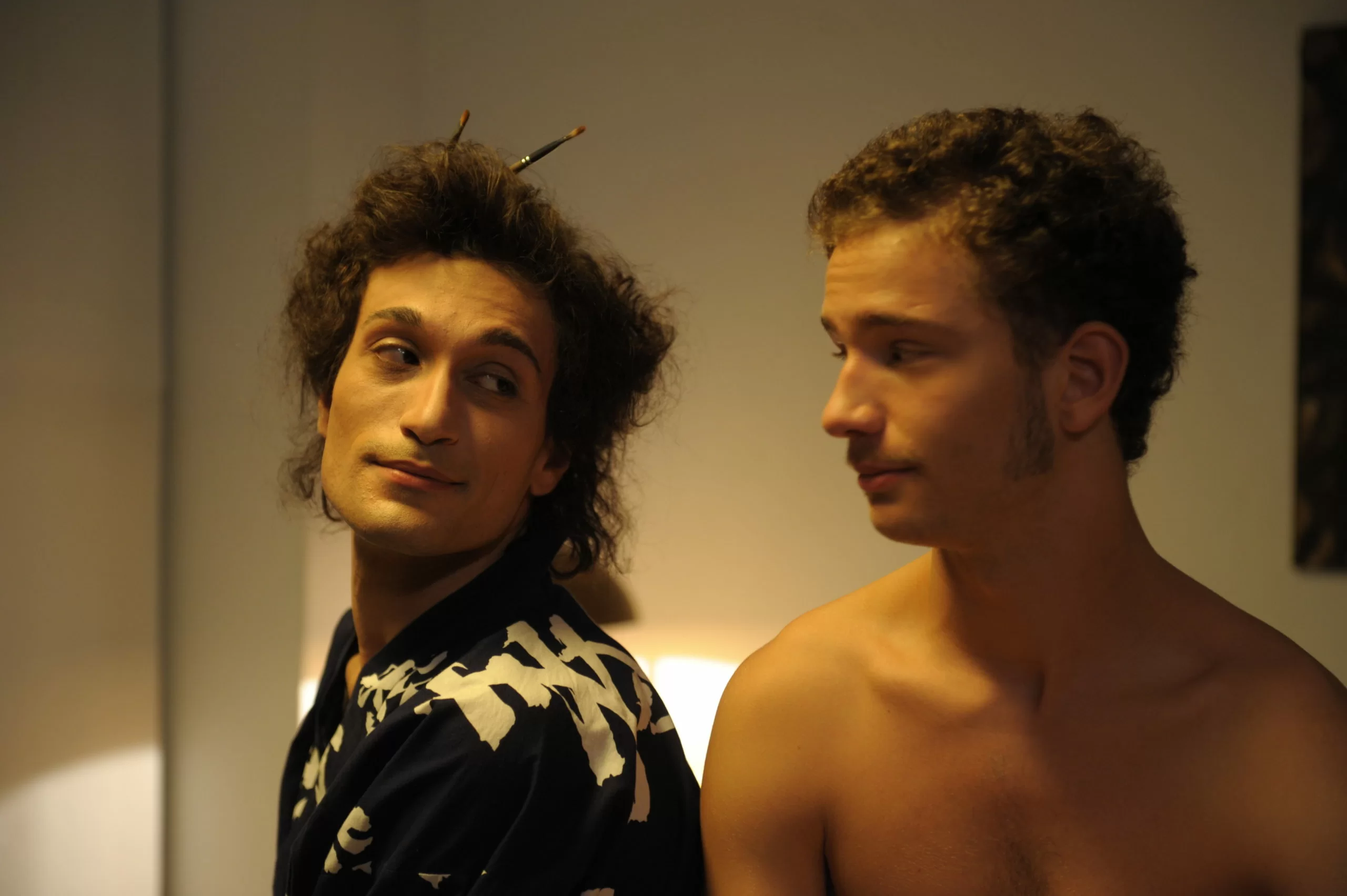
Gli anni amari offers a cinematic portrait of Mario Mieli that sits midway between biographical reconstruction and a symbolic rendering of an era. The narrative traces his trajectory from his Milanese adolescence—with the emblematic opening school essay in which he writes, “My name is Mario. Or, if you prefer, Maria”—through his political maturation, performative radicality, philosophical work on bodies and identities, and, ultimately, his tragic end. What emerges is the profile of a complex and contradictory intellectual, abrasive and visionary, capable of embodying a scandalous and uncomfortable truth, lived both as a vital force and as a sentence. His activism, cross-dressing understood as a political gesture, provocative writing, and theatre as a space of collective manifestation turn a personal biography into a political and aesthetic manifesto. In this sense, the film rescues Mieli from the stereotypical simplifications of martyrdom or the revolutionary hero, returning him as a living, disarming figure—at once brilliant and fragile. The film therefore inscribes itself within the tradition of political and militant Italian cinema of the 1970s—think of Bellocchio or Bertolucci—now increasingly rare. Gli anni amari positions itself as a “counter-film”: against institutions, discrimination, respectability politics, and a bigoted society, while steeped in ’68 counterculture and capable of conveying the spirit of a decade that conceived sexuality, affectivity, and the body as instruments of political struggle and social transformation. The work stages a turning point in Italian cultural and political history, tying Mieli’s individual arc to the collective movements that shaped his context: the student protests, women’s and LGBT emancipation, the struggles of political collectives, the use of psychedelic drugs as tools of exploration and liberation, and the sombre climate of the “Years of Lead,” evoked through references to the murders of Lorusso and Pasolini and the Moro kidnapping. In Mieli, personal freedom and collective freedom are inseparable, and the body becomes the primary site where politics takes shape—a place of resistance but also of vulnerability. Andrea Adriatico’s direction opts for a style that is both melodramatic and restrained, avoiding excessive pathos or spectacle. This formal choice coheres with Nicola Di Benedetto’s performance—his film debut—lending the character a slender physicality and a register of acting based on evocation rather than emphasis, measuredly conveying the tension between public exuberance and private fragility.
Stereotypes & strategies of inclusion
In Gli anni amari, inclusion is not reduced to a purely representational gesture but entails a genuine shift in perspective: we do not look at Mario Mieli “because he is different,” distant from the heteronormative, bourgeois models of the time; rather, we inhabit his gaze, adopting his worldview as the point of entry into the story. Sexuality is neither spectacularized nor relegated to something picturesque; it is placed at the centre of the philosopher’s political and affective itinerary. The body becomes a terrain of conflict and liberation, the primary site where the struggle for individual and collective autonomy is waged.
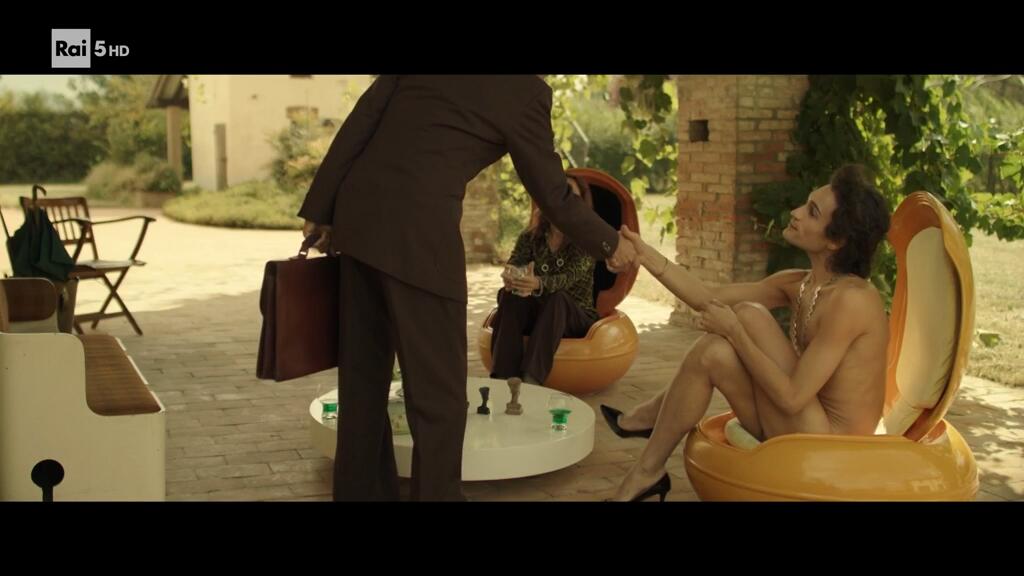
In this direction, the film also chooses not to gloss over the shadows: depression, schizophrenia, isolation, and suicide are not erased but integrated as constitutive parts of a radical and tormented life. The resulting portrait saves Mieli from the comforting, edifying rhetoric of many biopics, returning his complexity, brilliance, and vulnerability
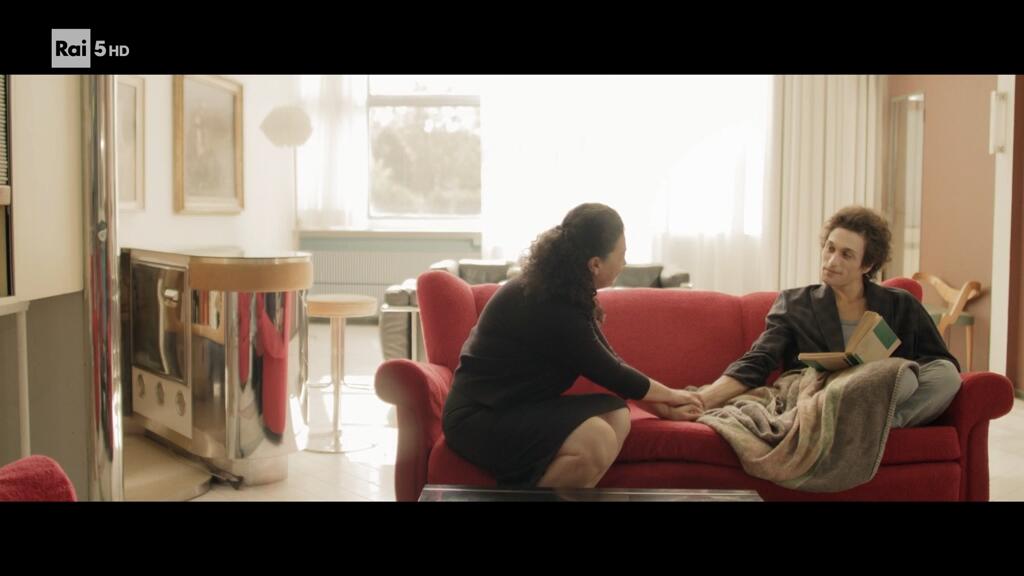
Yet the film is not without ambiguities. As some critics have noted, there is a certain reticence to fully confront Mieli’s political thought: while his biography is forcefully conveyed, his theoretical contribution risks receding into the background. The representation thus becomes more intimate than intellectual, more evocative than analytical. Indeed, Gli anni amari occupies a middle ground between militant cinema and television biopic, at times adopting a hagiographic approach and showing little inclination to problematize the legacy of Elementi di critica omosessuale (1977)—a foundational text that introduced the “homosexual question” in Italy as a political, social, and philosophical issue rather than a matter of private erotic “preferences.” In this sense, the film oscillates between a will to radicality and the risk of nostalgia, between uncomfortable memory and the aestheticization of remembrance. From a representational standpoint, however, Gli anni amari largely avoids celebratory drift: the protagonist is not transformed into a reassuring icon but remains an unruly figure capable of prying open the hypocrisies of bourgeois Italy during the Historic Compromise.
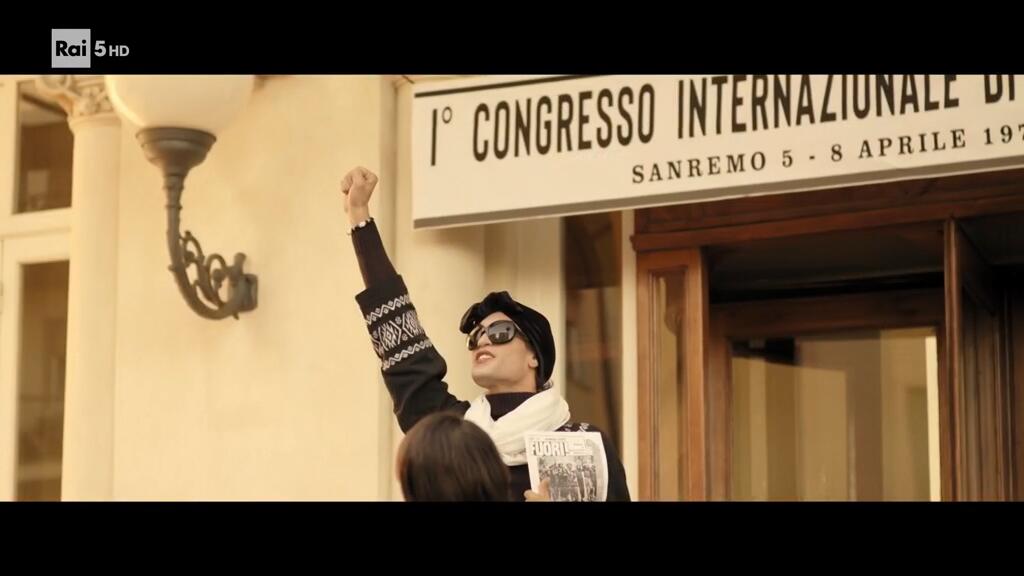
Appearances by Fernanda Pivano, Ivan Cattaneo, and Corrado Levi help reconstruct a web of intellectual and affective relations that situates Mieli within a resistant and creative community. On the acting front, Nicola Di Benedetto delivers a mimetic, persuasive performance: voice, movements, facial expressions, make-up, and costumes all convey his performative eccentricity, nonconformist vitality, and taste for provocation. The interpretation effectively renders a sensitive, tormented personality, hostile to any form of homogenization and marked by profound solitude. Despite certain limits, Gli anni amari reintroduces into the Italian landscape a central figure too long effaced, offering a model of inclusion which—though imperfect—distances itself both from marginalization and from reassuring rhetoric, restoring the power of an intellectual legacy that remains necessary and productively unsettling today.
Conversations
Director Andrea Adriatico discusses a scene inspired by the interviews on sexuality that Mario Mieli conducted for Rai with Alfa Romeo workers (Internazionale, July 27, 2020).
Business strategies and communication rhetorics
Strategies
Gli anni amari is an institutional co-production bringing together public and private entities: Cinemare, Rai Cinema, and Pavarotti International 23, produced by Nicoletta Mantovani and Saverio Peschechera, with support from MiBAC, the Emilia-Romagna Film Commission, and the Apulia Film Commission. Principal photography began on 20 August 2018 and took place in Milan, Bologna, Modena, Sanremo, Lecce, and London. Adriatico—trained in political theatre and long engaged with socially inflected narratives—imprints the film with a dimension of civic engagement. The choice to avoid spectacular solutions or excessive aestheticization yields a clear, pared-down mise-en-scène that concentrates attention on Mieli’s body and voice. The use of music and extended sequence shots contributes to a rigorous account that aims less to reinterpret the activist’s deviations and contradictions than to offer a coherent portrait. This production and stylistic stance raises critical questions. On the one hand, paying homage to a figure like Mieli is undeniably a necessary political and cultural act, especially in a national context that long removed or marginalized his theoretical and militant legacy. On the other, reducing a radical thinker—who made desire a privileged object of speculation—to a largely linear biographical dimension risks blunting the subversive force of his politics. Here the most evident tension between content and production context emerges: can such radical thought truly be narrated with the support of the very institutions—Rai, MiBACT—against which Mieli levelled some of his fiercest critique? The film seems to offer a partial answer: to obtain support and legitimacy, the narrative is softened in its most scandalous aspects and politically defanged. The result is a work animated by sincere passion and a drive for historical restitution, yet suspended in an unstable balance between militancy and institutionalization, between a desire for radicality and the necessity of compromise.
Communication rhetorics
The promotional strategy unfolded primarily through the festival and art-house circuits. The pre-opening gala at the 2019 Rome Film Fest conferred prestige but also a selective positioning, addressing a culturally attuned audience attentive to queer memory. Distribution—initially via digital platforms (Clever, Chili, Mubi, and later RaiPlay) and subsequently in art-house theatres—reconfirmed this vocation: not a mainstream roll-out but a product geared to active, specialized consumption. The pandemic had a significant impact: the release, originally slated for 12 March 2020, was postponed to 2 July 2020, compromising the possibility of broader circulation and of benefiting from a more favourable media environment. Promotional discourse emphasized the urgency of returning a radical, long-marginalized intellectual to national history, presenting the film as a work of civic and cultural memory. Emphasis fell above all on testimony and on the need to bring back to the fore a challenging, visionary thinker. Thus the communication framed the film as “counter-current,” a militant project that embraces the courage of its difference, positioning itself as a critical alternative to the mainstream. Yet the promotion also revealed an internal tension: on the one hand, a call to identity pride and to reopening debate on sexual freedom; on the other, a cautious profile regarding the most controversial aspects of Mieli’s thought. His more extreme provocations—such as statements on pedophilia, conceived as radically scandalous, and the theorization of coprophagy as a political act—are barely hinted at in the film and absent from the official campaign, which favoured a more reassuring portrait emphasising civic courage and existential rebellion. This choice drew criticism but can be read as deliberate: privileging a testimonial and pedagogical function, proposing Mieli as an icon of freedom and rebellion rather than as an apocalyptic, divisive thinker. Such selectivity, while tempering his original radicality, enables the film to speak to a broader audience, reaffirming the value of queer memory as a space of cultural and political resistance.
Conversations
“Lorenzo Balducci: ‘Let me tell you about the bitter years of Mario Mieli’”. In Gay.it, October 13, 2019. Gabriele Ottaviani interviews actor Lorenzo Balducci.
«To return to talking about Mario Mieli, to make a film, to bring him back to the centre of attention, is a necessity. Mieli has been forgotten by many; many others don’t even know who he is. What I love about him is his sense of challenge, of provocation and struggle that were always part of his personality. His work is extraordinary, totally free and innovative—just like his life. I am moved by the honesty of his thinking, of his pain, and by the importance he assigns to the body as a tool of freedom»
Circulation and audience responses
Circulation patterns
Gli anni amari followed a distribution path typical of politically and identitarian-oriented art-house cinema. Premiering on 16 October 2019 at the Rome Film Fest in the pre-opening slot, the film immediately assumed a selective profile, more oriented to cultural circuits than mainstream consumption. Italian distribution, by I Wonder Pictures, was initially scheduled for 12 March 2020 (the anniversary of Mieli’s death), but the COVID-19 pandemic postponed the release to 2 July 2020, reducing the opportunity to reach a wider audience at a moment of heightened media attention. In theatres, the film circulated chiefly on the art-house circuit, in line with its authorial and militant nature. Internationally, sales were handled by The Open Reel, with deals in Canada, France, Spain, Portugal, and the United States. Here, too, the strategy favoured a festival- and cinephile-oriented target attuned to queer and biographical narratives. Participation in numerous international festivals consolidated the film’s image as a “niche” product with strong recognisability in thematic networks: from Calgary’s Fairy Tales Queer Film Festival to Mexico City’s MIX Festival, from Montreal’s image+nation to the Ljubljana LGBT Film Festival, and established European events such as Chéries-Chéris in Paris and Des Images aux Mots in Toulouse, alongside Italian stops like Ravenna Nightmare Film Festival and Sardinia Queer Film Expo. This festival circuit confirms the work’s transnational vocation—speaking to global queer communities through the recovery of a “local” figure such as Mieli—while its selectivity limited reach among the general public: the queer memory promoted by the film thus remained channeled through audiences already predisposed to listen, without fully breaking the silence and marginalization that have historically accompanied Mieli in Italy.
Reception
Critical response was varied: many recognised its civic force and the importance of restoring Mario Mieli to the centre of Italian cultural debate, while also voicing reservations about formal cohesion and the film’s ability to do full justice to the character’s complexity. Nocturno called the film an “engaged and disenchanted counterpoint” to national-popular fiction, underscoring its desire to summon militant memory and ’68 counterculture at a time when Italian cinema tends to erase conflict. In the same vein, il manifesto read it as a rare and necessary portrait that restages Mieli’s challenge to familial and social conformism, while risking to reduce his legacy to an aesthetic icon more than to a radical political thinker. Many critics highlighted the strengths and limits of the screenplay. Cinefilos.it appreciated the evocative power of certain sequences but lamented a degree of emotional distance that prevents full immersion in the protagonist’s subjectivity. Sentieri Selvaggi offered a nuanced reading: on the one hand, it praised the soundtrack—ranging from Sylvie Vartan to the Dik Dik, from Raffaella Carrà’s “Rumore” to Ivan Cattaneo (who also appears as a character)—and the playful tone of some choices; on the other, it warned against a surplus of theoretical exposition that risks draining power from the image. From this perspective, the film indulges in an excess of information, eroding part of the sensory and emotional force that could have made it more incisive. Other voices were more critical. Quinlan underscored the limits of an operation that, despite good intentions, risks becoming a “by-the-book” account—prolix in saying and restrained in being. The review pressed the question of institutionally representing a subversive thought such as Mieli’s, asking whether it is possible to narrate his radicality through the very apparatuses that historically marginalized his voice (note the funding by Rai Cinema and MiBACT). From this angle, the film, even as it pays homage to his legacy, seems in part defanged, unable to transubstantiate the power and vitality of Mieli’s thinking into cinematic image. Ultimately, the reception of Gli anni amari mirrors the fate of its protagonist: divisive, impassioned, capable of generating identification as well as diffidence. Recognised by many as an indispensable act of civic and cultural memory, the film is also criticised for struggling to translate theoretical radicality into film language. It is precisely in this tension that its importance lies: less as a definitive, fully accomplished work than as a tool for reopening a debate that continues to question contemporary Italy.
Conversations
“Gli anni amari. A film to rediscover and the necessary rediscovery of Mario Mieli”. In The Hot Corn, November 17, 2020. Francesca Fiorentino interviews director Andrea Adriatico.
«This film, for me, is a moment of liberation—the conclusion of a long and not simple journey. Making a film about a homosexual man is still uncomfortable».
Italian and foreign press
Italian Press
Valentina Pietrarca, “Andrea Adriatico on Gli Anni Amari and the Story of Mario Mieli”, TaxiDrivers.it, August 5, 2021.
«Gli anni amari is thus a liberating cry, a film that serves to pass the baton—to amplify and disseminate Mieli’s legacy, his ardour, his anger, his irrepressible thirst for freedom. And who knows, perhaps it may even help create a society in which a Mario Mieli could truly live fully free».
Antonio D’Onofrio, “Gli anni amari by Andrea Adriatico”, Sentieri Selvaggi, July 2, 2020.
«The film faithfully accompanies each of these status-shifts; it neglects the personal deflagration, as if the bodily dissociation were unexpected and not the result of a pain that also passed through hospitalization. It chooses to be predominantly playful, with a lexicon of vulgarity reserved for the domestic sphere—the breeding ground of every ill. Perhaps it overuses authors and concepts—in a continual poetic and philosophical reformulation—thereby eroding part of the image’s power. It is authentic and convincing in its musical dimension—from Sylvie Vartan’s ‘Abracadabra’ to the Dik Dik, to Raffaella Carrà’s ‘Rumore,’ up to Ivan Cattaneo, who also appears as a character. The surplus of ‘information’ leaves the general thrust intact: a cry of freedom of which there is always great need».
Raffaele Meale, “Gli anni amari”, Quinlan, 12 luglio 2020.
«There is a calligraphic imitation of a life in the reliance on anecdote, but the life of the film itself is missing. Thus, the effectiveness of the performances inevitably suffers, as do the more interesting intuitions (the staging of the suicide is appreciable, for example). Honouring a human experience like Mieli’s is a duty; one cannot but appreciate the good intentions and passion invested in studying his life and thought. But precisely because his political thought has been structurally suppressed (even within certain sectors of the homosexual community), it is a pity to see the film reduced to a ‘by-the-book’ account—prolix in saying and perhaps restrained in being. Faced with a free thinker who made desire one of the principal objects of his speculation, more could have been dared: to work on the image as a burning altar of desire, to turn the immaterial into flesh. It is highly likely that, had the operation taken that direction, RAI and MiBACT would have withdrawn in haste. Hence the question returns: can one narrate a subversive thought by resorting to the very institution against which that thought agitated, in order to obtain funding? The risk is that the answer is negative—unless one sugarcoats that thought, normalizing the image and effectively impoverishing it. Cinema, too, when it fails to free itself from society’s bonds, risks becoming a victim of ‘educastration,’ as Mieli would have put it—and of suffocating».
Davide Comotti, “Gli anni amari”, Nocturno.
«By a strange twist of fate, while Gabriele Muccino is scoring a hit with his usual edulcorated generational epic, Gli anni più belli, Gli anni amari by Andrea Adriatico also reaches theatres: which seems, as if by design, the counterpoint to Muccino’s national-popular dramedy—both in title and substance. On one side, a mainstream, consolatory film; on the other, an engaged and disenchanted journey through one of the most debated and delicate cultural movements—and moments—of our history: Gli anni amari recounts the life of Mario Mieli (1952–1983), writer, intellectual, activist, and homosexual performer, a key figure in the founding of the Italian LGBT movement, who died by suicide at thirty».