


Inside Ciambra: Identity, Roots, and Borderland Landscapes
by Massimiliano Coviello
Overview
August 31, 2017
120′
Jonas Carpignano
Jonas Carpignano
StayBlack, RT Features, Rai Cinema, DCM, Haut et Court, with the contribution of the Ministry of Culture, Sikelia Productions, Film I Vast, Filmgate, supported by Lucana Film Commission, Calabria Film Commission Foundation
Tim Curtin
Affonso Gonçalves
Dan Romer
Pio Amato, Koudous Seihon, Iolanda Amato, Damiano Amato
Academy Two
Gallery
Poster




Trailer
Pressbook
Representation strategies, rhetorics and stereotypes
Narrative & characters
Jonas Carpignano, born in 1984 in New York to a Barbadian mother and an Italian father, spent long periods in Rome before relocating in 2010 to Gioia Tauro, Calabria. The microcosm of the Gioia Tauro plain became the ideal setting for a series of multilingual, multiethnic films. Encounters with exploited migrant laborers in the orange groves of Rosarno, with the Roma community of the Ciambra—a cluster of run-down public housing—and finally with local Calabrian families, enabled the director to shape the characters and storylines of his films. His three feature films—Mediterranea (2015), A Ciambra (2017), and A Chiara (2021)—interspersed with an equal number of short films, give form to a cohesive story world. Over the years, the life stories of non-professional actors have become the point of departure for constructing believable narrative arcs, which often intersect. This poetic and production choice allows Carpignano to develop a layered storytelling approach, deeply rooted in the social and geographical fabric of contemporary Calabria. The continuity of spaces, characters, and family dynamics strengthens the impression of a coherent, evolving world, in which each film adds a further perspective, probing themes such as identity, migration, generational conflict, belonging, and the encounters and clashes between communities.
From one film to the next, characters reappear and evolve, creating a narrative continuum in which their fictional existence becomes inseparable from the real biographies of the actors portraying them. Pio Amato, a young Roma boy and the protagonist of A Ciambra, first appears in Mediterranea, a film that intertwines the uprising of agricultural laborers in Rosarno with the personal story of Koudous Seihon, a Burkinabè immigrant who plays himself under the name Ayiva. Over time, a friendship develops between Koudous and Pio, one capable of transcending cultural and social barriers—a human bond that Carpignano incorporates into his narrative universe, only to put it to the test. In A Ciambra, Pio betrays Ayiva’s trust and, albeit reluctantly, takes part in stealing from him.
In A Chiara, Pio reappears briefly: Chiara (played by Swamy Rotolo) encounters him and his family by chance in the Ciambra. Unlike Pio, Chiara is unaware of the hidden realities surrounding her and embarks on a journey of discovery marked by silence, lies, and unspoken family truths. After uncovering her father’s criminal ties, she accepts the help of social services and leaves Calabria to rebuild a new life in Urbino

Pio is the only one among the three protagonists who retains his real name within the cinematic fiction. In A Ciambra, he undergoes an early rite of passage into adulthood, set within a marginal environment governed by strict codes. From a young age, Pio learns to navigate petty theft, illicit dealings, and ambiguous relationships with other local communities—particularly the African and Calabrian groups—with whom he engages in exchanges marked as much by exploitation and mistrust as by cooperation. The words spoken to him by his grandfather provide an interpretive key to the story: the freedom of a once-nomadic past has given way to a present defined by isolation, suspicion, and a constant struggle against a surrounding world perceived as hostile.

When his father and brother are arrested, Pio takes on the responsibility of providing for his family. Yet it is only after helping his recently released brother rob Ayiva’s warehouse that he is acknowledged as an integral member of the community, ready to step into adulthood according to the rules of the Ciambra.
Stereotypes & strategies of inclusion
In A Ciambra, as in Carpignano’s other films, the staging of the protagonists’ lives—often residents of the area themselves—overcomes the dichotomy between documentary and fiction, producing a hybrid narrative form that conveys the complexity of social ties and local context. The camera follows Pio and the other characters with a participatory, immersive gaze, before widening its focus to encompass the spaces and conflicts that shape and divide the various communities. In doing so, it avoids any exoticizing or moralizing stance. The following analysis examines some of the sequences that trace the protagonist’s process of growth and coming of age.
Encounters at the Margins

Pio is drawn to the margins, both physical and symbolic. The boundaries he crosses are those of the Roma neighborhood, the streets he traverses on foot, by bicycle, or by scooter, which take him through other peripheral zones between Gioia Tauro and Rosarno. Pio is, in every sense, a crosser of peripheries. His movement is constant and restless, nearly impossible to contain. The camera stays close to him, visually capturing his feverish energy. His ability to connect with the different communities inhabiting Calabria is exemplified by his relationship with Ayiva and the other migrants. Pio is cheered by them when he brings a television set to their tent camp so they can watch a football match. After a clumsy attempt to break into the villa of a ‘Ndrangheta boss dealing with the Roma, Pio seeks refuge in Ayiva’s makeshift home.
The Fear of Enclosed Spaces
Pio grows restless inside the home: he smokes nervously, steals, runs, dashes about. Yet this drive toward the outside collides with his fear of enclosed spaces. His claustrophobia emerges in two key moments: when his older brother forces him to take the elevator, and when, after a theft, he hides in the train’s restroom with his sister to escape the ticket inspector. This claustrophobia becomes a marker of a subjectivity that resists imposed constraints and boundaries.
Oneiric Realism

In A Ciambra, the realism of the mise-en-scène is interrupted by two dreamlike sequences. The first, placed at the beginning of the film and resembling a flashback, shows the grandfather as a young man with a horse. The scene evokes the community’s nomadic roots and its historical memory. The second, premonitory in tone, precedes the grandfather’s death: he appears on horseback circling a bonfire, in a suspended image that takes on a ritual dimension.
Coming of Age

The boundaries Pio navigates are not only spatial: they also signal the rites of passage that grant him early recognition as an adult. His path to maturity culminates in a painful decision: betraying Ayiva, his African friend, in order to be accepted and acknowledged within his own community, embracing both its rules and its fate.
In the final sequence, this transformation is conveyed visually through a carefully composed spatial arrangement: the characters are divided into two distinct groups—on one side the children (linked to play), on the other the adults (associated with choices and responsibilities). As the image blurs, Pio’s passage from one group to the other symbolically marks the completion of his developmental journey, transfiguring space in ritual terms.
Conversations
“The Human Landscape”: Carpignano’s masterclass at the University of Calabria (January 13, 2022).
“The Process Is Everything”. Sentieri Selvaggi, no. 11, January/February 2022. Federico Chiacchiari, Simone Emiliani, Pietro Masciullo, Sergio Sozzo, and Aldo Spiniello interview director Jonas Carpignano.
«Since I already knew Koudous and Pio well, it was very easy to carry these characters and their narrative arcs forward into the later films. […] Pio entered our world at the age of ten; it was natural to include him in Mediterranea. From there came the idea of making a film about him and his family, while maintaining the connection with Koudous».
«People often say that Gioia Tauro is my laboratory, that I am there to study and do research for a film. That’s not the case—if anything, it’s the opposite. […] When I make a film, I try to remain as faithful as possible to the characters. […] I am very interested in how Pio relates to the world outside the Ciambra; in fact, the bond he has with Koudous resembles, in many ways, the one he has with me».
«It is important for people to realize that Calabria is not what is too often shown on television or in cinema. […] At the same time, this land has a very strong relationship with tradition and with the past—much more so than any other place I have lived before. […] That is why I wanted to include the scenes with Pio’s grandfather. It had to be clear that Pio felt himself part of a long tradition: that community has managed to survive in this context since the 1930s, thanks to the solidarity that comes from tradition».
“The Body of the Real.” Filmidee, April 19, 2018. Alessandro Stellino interviews director Jonas Carpignano.
«For me it is essential that the camera reflect the character’s point of view. In Mediterranea, the story may seem fragmented because that is precisely how Koudous perceives the world around him. I discover places through my characters, not the other way around: I don’t use the character to explore a place. When Pio moves through Gioia Tauro in A Ciambra, that environment is normal for him, whereas anyone else might say, ‘My God, what an ugly place.’ If I wanted to convey something like that, I would widen the shot—but I don’t, because the point of view belongs to Pio, and he is not concerned with saying the place is ugly. For me, the relationship between the character and the camera matters more than any sense of wonder the image might produce».
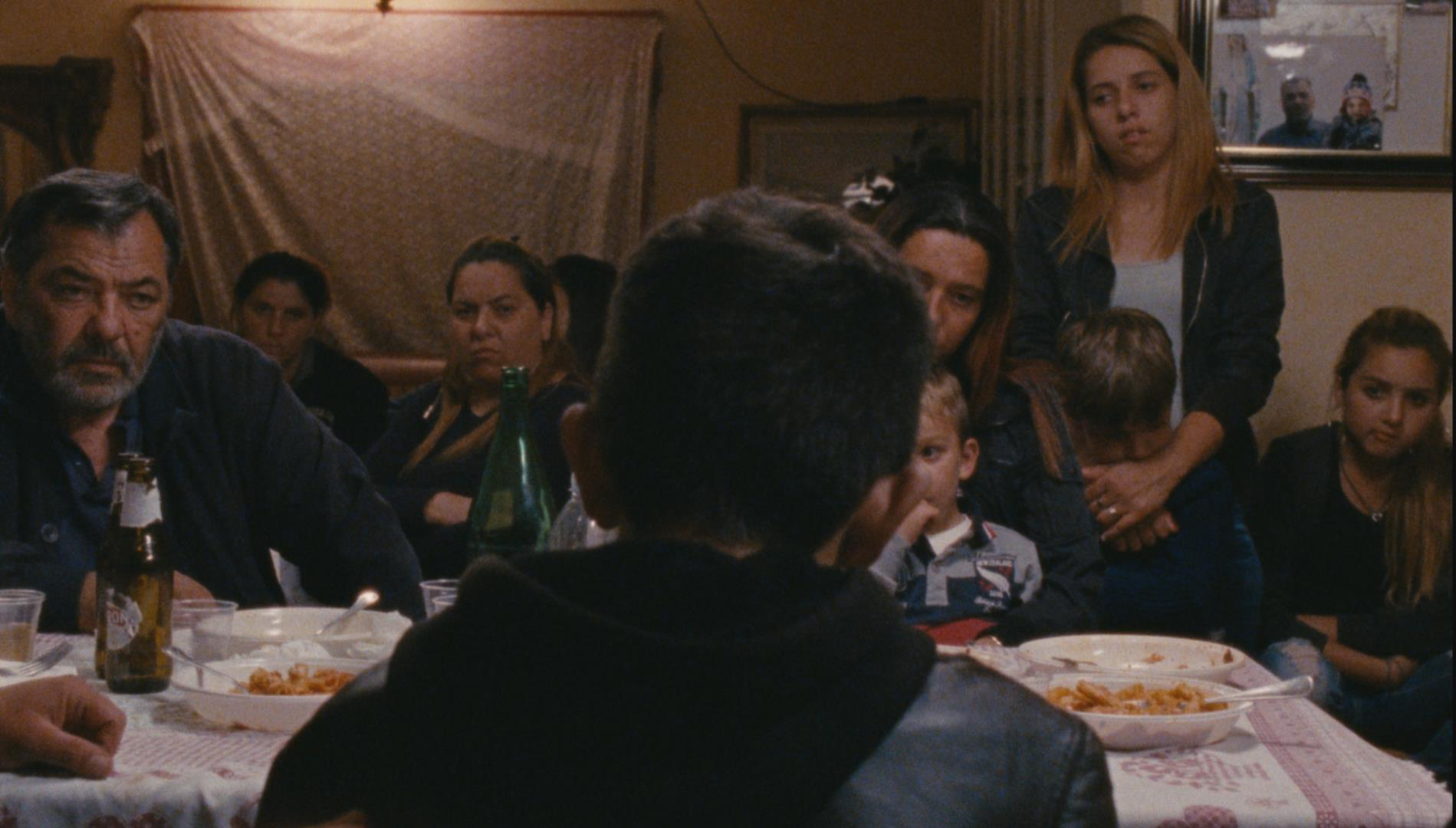
«I don’t like using dialogue to explain characters. What interests me is not what they tell me, but what they do, what I see when I am with them. So we try to place the camera in the ideal position to understand how the characters are feeling. For example, in the dinner scene of A Ciambra, I wanted to create the impression that we were sitting at the table with them, so the camera is placed exactly where I would be if I were seated there».
Business strategies and communication rhetorics
Strategies
The total production cost of A Ciambra amounted to €1,370,000. The contribution from the Directorate General for Cinema and Audiovisual was €167,931.55. The film was also made with the support of the Lucana Film Commission and the Calabria Film Commission Foundation. Additional funding came from France, in particular from the Ministère des Affaires étrangères et du Développement International and from the CNC’s Aide aux Cinémas du Monde program.
In many interviews, Carpignano has recounted how the idea for the film originated from a chance episode: his encounter with the Amato family occurred after his car was stolen, along with all the film equipment inside. At the time, the director and his crew were in Gioia Tauro shooting A Chjàna (2011), the short film that would later give rise to Mediterranea. It was the meeting with Pio and with the Roma community that led Carpignano first to make a short film and then a feature film set in the Ciambra.
Carpignano often adopts a workshop-like approach to directing, producing short films as preparatory stages for his features. These shorts serve a dual purpose: on the one hand, they provide training for non-professional actors, who must become familiar with the camera and learn how to transpose their life experiences into a narrative structure; on the other, they function as genuine preliminary studies, sketches through which the director tests the stylistic and narrative coherence of the project, experimenting with the construction of character in relation to environment. Finally, the short film also operates as a strategic tool to gain visibility and attract funding. A Ciambra (2014), for example, was selected for the Semaine de la Critique at the Cannes Film Festival, generating producer interest and enabling Carpignano to make Mediterranea.
A Ciambra is an independent film, made with a modest budget yet supported by international production and a multicultural crew of professionals from different countries. Notably, it was the first film produced through an international film fund aimed at emerging directors with a strong authorial vision. The project originated from the collaboration between Martin Scorsese’s Sikelia Productions and Brazilian producer Rodrigo Teixeira’s RT Features.
Scorsese, who had already admired Mediterranea, chose to support A Ciambra as executive producer: he assisted Carpignano in securing funding, promoting the film, and, during post-production, offered advice on the editing process.
Communication rhetorics
A Ciambra employed targeted promotional strategies to ensure visibility both within Italy and on the international stage. Central to this process was the support of Martin Scorsese, who discovered the film after seeing Carpignano’s earlier work, Mediterranea. Struck by the script and by the project’s visual strength, Scorsese decided to accompany the director from the development stage onward. His involvement proved crucial not only on the production side but also in the promotion of the film, particularly in the United States, where he acted as a genuine “ambassador,” contributing to its distribution and strengthening its international profile.
A second axis of promotion involved participation in film festivals, beginning with the Quinzaine des Réalisateurs in Cannes, which secured several awards and established the film’s authorial reputation, culminating in its submission as Italy’s entry for the Academy Awards.
Finally, the film’s communication strategy emphasized the interplay between the director’s creative vision and the specificities of the narrative context: a balance between authorial perspective and the representation of territorial marginality, with particular attention to the r community of the Ciambra.
An example of this strategy is A Ciambra – The Other Side of the Story (2017), a documentary by Paolo Carpignano—sociologist, father of the director, and co-founder of the production company Stayblack—which provides a detailed account of the set and of Carpignano’s working method. Through behind-the-scenes footage, moments of everyday activity on set, and interviews with cast and crew, the documentary reconstructs the creative process of A Ciambra, focusing in particular on the relationship between the director and the non-professional actors, the writing of the screenplay, and the rooting of the narrative in the real context of the Roma community in Gioia Tauro. The Other Side of the Story thus emerges as a valuable tool for reflecting on independent and transnational filmmaking, as well as on the increasingly porous boundary between fiction and reality
Conversations
“A Ciambra – The Other Side of the Story.” Sentieri Selvaggi, December 10, 2017
«As production designer Ascanio Viarigi explains: “A film like this is very close to the reality of things and could almost seem like a documentary, were it not for the fact that there is acting involved, there is a script behind it, and there is careful work on framing and lighting. Shooting within a community that remains, after all, a closed one—such as the Roma of the Ciambra in Gioia Tauro—was by no means an easy task. My relationship with the community began many years ago and has deepened enormously because, beyond the film, I have often helped Rocco and the Amato family fix up their home, put their kitchen in order».
«Carpignano recalls how community stories often became inspiration for the script: “Iolanda once told me, over dinner, about seeing that Moroccan man in the hospital—she had actually told me the story years earlier. I took it and inserted it into the screenplay because I wanted to show the Roma perspective on immigrants. To get her to perform it, I did this: since I eat with them at least three or four times a week, I would ask her at the table to tell me the story again. It was almost like rehearsing, except she didn’t know it. That way, when we shot the scene, she was ready».
Producer Gwyn Sannia describes the challenges of working on location: «Those of us who are not from Gioia Tauro have to learn to understand and respect this place. Even if sometimes you want to do things your own way for the good of the film, you need to find a balance between what has to be done day by day and how to talk to people here, without disturbing certain balances. And then there is the Ciambra, which is a world of its own, a separate entity. If you think you can organize the film in the Ciambra as you would a normal production, it’s absolute chaos, a nightmare. There are days when people are available, when everything seems to work, and there are other days that are a complete disaster».
“Jonas Carpignano, Calabria in A Ciambra between Fiction and Reality.” Il Manifesto, August 23, 2017. Giovanna Branca interviews director Jonas Carpignano.
«In telling this story the director chose an approach halfway between documentary and fiction: all the characters in fact play themselves, but they act out a screenplay. “I wrote A Ciambra thinking of them, of Pio, so in the script they say things I had personally heard them say—explains Carpignano—for example, there is a scene where Pio’s family is chatting during dinner that looks very much like a documentary. But the things they say to each other were things they had already told me on other occasions: when I visited, I would ask them to recount again the stories that had struck me. They didn’t know it, but we were already rehearsing».
«He and his family, the director recounts, were never hostile to my presence as a filmmaker or to the idea of being portrayed. “They are more distrustful of journalists—for example, those from Striscia la notizia, who come to do their reports on the neighborhood and then disappear, making them feel mocked. With me they worried about being filmed in pajamas or things like that, but theft is not something they want to hide:they see it as work. In fact, once the film was finished, they were angry when they saw that I had cut a theft scene”. But the film avoids any moral lesson: “I don’t have a message I want to transmit to the audience. I simply want to make this reality known”».
Circulation and audience responses
Circulation patterns
Circulation between Italy and the United States
In his essay on the production and international circulation of A Ciambra, Damiano Garofalo reconstructs in detail the trajectory of Jonas Carpignano’s film, from festivals to distribution, highlighting in particular its dual path between Italy and the United States.
After its premiere at the Quinzaine des Réalisateurs of the 2017 Cannes Film Festival, where it received the Europa Cinemas Label Award, the film achieved international visibility primarily through the festival circuit. This recognition enabled A Ciambra to benefit from the support of the Europa Cinemas Network, which promoted its dissemination and screenings across Europe by offering incentives to exhibitors.
Theatrical distribution, however, remained highly limited: in Italy the film was released on August 31, 2017, distributed by Academy Two in only 27 theaters, earning a total of €26,000. This modest result reflects the broader difficulties faced by independent and art-house cinema in reaching the national market.
In the United States, A Ciambra was distributed by Sundance Selects, a New York–based subsidiary of IFC Films and one of the leading distributors of European independent cinema overseas. Here too, its release was confined to an extremely limited circuit—only five prints—and the box office gross amounted to around $41,000. This figure, however, was higher than in Italy and represented nearly half of the film’s total worldwide earnings, approximately $104,000.
Despite its limited commercial success, the film received significant institutional recognition: it was selected as Italy’s entry for Best Foreign Language Film at the 90th Academy Awards, although it did not secure a nomination.
European Circulation
In Europe, the distribution of A Ciambra involved a wide range of companies. In Austria, Germany, and Switzerland, the film was released by DCM. Haut et Court handled distribution in France; Arti Film managed Belgium and the Netherlands; and Peccadillo Pictures brought the film to the United Kingdom and Ireland. In the Balkans, Demiurg played a central role, distributing the film in Albania, Bosnia and Herzegovina, Croatia, Serbia, and Slovenia, thereby highlighting a regional group strategy. Other European markets included Denmark with Angel Films, Poland with Vivarto – Bomba Film, and Portugal with Leopardo Filmes. In Norway, the distributor was Storytelling Media.
Beyond Europe, A Ciambra reached audiences across several continents. In Canada, distribution was entrusted to IFC Films – Sundance Selects. In Latin America, Zeta Films brought the film to Argentina, Providence Filmes – Pandora to Brazil, and ND Mantarraya to Mexico.
The Asian market also showed interest, with Time in Portrait distributing the film in China and Musashino Entertainment in Japan. In the Middle East, MAD Solutions handled distribution in Egypt and the United Arab Emirates, while Fabula Film released the film in Turkey.
Awards and Festivals
A Ciambra received the Prix Sergio Leone at Annecy Cinéma Italien in 2021. In the same year, the Festival Premiers Plans d’Angers dedicated a retrospective to Carpignano, focusing on the director’s body of work.
In 2018, A Ciambra earned several honors at the David di Donatello Awards, winning prizes for Best Director and Best Editing. The film also received the Horizon Mention at the Beijing International Film Festival and the Ciné Jeunesse award at the Festival du Cinéma Italien de Bastia.
At the 2017 edition of the Festival Cinéma Méditerranéen de Bruxelles, the film was given a Special Mention for Pio Amato’s performance. Pio was further recognized with the Best Actor Award at the Festival de Cine Europeo de Sevilla. At the prestigious Cannes Film Festival, within the Quinzaine des Réalisateurs, A Ciambra was awarded the Europa Cinemas Label, while at Film Fest Gent it won the Georges Delerue Award for Best Music. Finally, at CPH PIX the film was honored with the Politiken Audience Award. The Italian National Syndicate of Film Critics designated A Ciambra as Film della Critica (Film of the Critics).
Reception
Italian and international critics have emphasized the originality of Carpignano’s approach to screenwriting and directing, as well as his work within the Roma community of Gioia Tauro—particularly his ability to construct a coming-of-age story without adopting a moralizing gaze. Several articles have explored the contribution of Scorsese, the valorization of peripheral locations and marginalized subjects, and the blending of fiction and documentary, situating A Ciambra within the so-called “cinema of the real.” They have also pointed to references to diverse cinematic traditions, from Neorealism to New Hollywood, and to directorial styles ranging from Rossellini to the Dardenne brothers.
Italian and foreign press
Italian Press
Massimiliano Coviello “Emotional Cartographies of Communal Spaces: The Cinema of Jonas Carpignano”, in The Landscape of Authors: Cinema and Southern Imaginaries, ed. Roberto De Gaetano, Daniele Dottorini, Nausica Tucci, Luigi Pellegrini, Cosenza, 2023.
«It is the women and men framed and then reframed through the screen who compose the image of the territory, the cartography of a marginal world made of waste, concrete, and sheet metal. Torn between environment and landscape, suspended between action and contemplation, the characters in Carpignano’s cinema survive through a desire for exploration and a need for recognition. Migrants and adolescents are the subjectivities through which Carpignano attempts an apprenticeship in vision toward a territory such as Calabria—one for which the urgency of undertaking new paths and charting new maps is ever greater. In this apprenticeship in vision, aimed at constructing a new southern cartography, Carpignano draws upon elements from the history of cinematic forms, hybridizing them into a personal style. The use of non-professional actors portraying marginal social roles, the choice of peripheral spaces, and the way the camera ‘stays with’ the character—shadowing them and at times even reproducing their perspective through semi-subjective shots—are clear references to Neorealism, in particular to the films of Rossellini, De Sica, and Zavattini. The protagonists’ stubbornness, the closeness expressed by Carpignano in proxemic and representational terms, and their extreme choices recall the characters of the Dardenne brothers’ cinema. The attention to dramaturgical writing founded on the coming-of-age narrative, the thematic choices, and the use of an acting practice in which the distance—both biographical and emotional—between actor and character tends to collapse recall the cinema of Scorsese and the techniques of the Actors Studio. All these elements coexist within a style that is above all documentary, which, while hybridizing participatory observation with fictional reconstruction, remains consistently connected to the world it seeks to shape».
Pietro Masciullo “The Story of the Exodus as a Rearticulation of Filmic Forms: Jonas Carpignano and Twenty-First-Century European Cinema”, SiGma. Journal of Comparative Literatures, Theatre and Performing Arts, no. 7, 2023
«The film opens with a long shot of a hilly landscape. A dappled white horse grazes on the slope; a man slowly approaches and then strokes the animal’s thick mane. Another long shot now frames him by a stream as he prepares water with lemon; in the background we see a small nomadic settlement and the white horse tied near the family cart. Cut: the film’s title appears in superimposition. We are now in the Roma community of Gioia Tauro, where we immediately recognize young Pio Amato, now grown up since we last saw him as little more than a boy in the previous film, Mediterranea. Pio quarrels with his older brother, is then scolded by his sisters, and hurries off to prepare water with lemon for his grandfather. The old man sits silently waiting as Pio places the glass on the table and runs off; from the detail of the grandfather’s hand, the handheld sequence pans to frame his youthful portrait hanging on the wall beside him. In that image we recognize the man with the horse seen earlier. In short: in A Ciambra the reference to the founding myth of a nomadic community (the patriarch gazing at the horizon beside the encamped cart) is instantaneously reconfigured through the stylistic codes of classical Hollywood cinema».
Alessandro Canadè, “On the Threshold. A Ciambra by Jonas Carpignano”, Fata Morgana Web, September 21, 2023.
« Immersing itself in the ‘neorealistic’ reality of a Roma camp in the province of Reggio Calabria (a real place, just as the protagonists are real people playing themselves under their own names), the film tells us a story of growth. A coming-of-age novel in which the openness and incompleteness of the novelistic form is hybridized with the closed form of the Hollywood ‘action’ narrative. The rite of passage of the young protagonist, Pio, is structured according to the neo-Aristotelian narrative model of mainstream American cinema: the canonical three acts (setup, confrontation/conflict, and resolution), which in turn correspond to the three phases of separation, initiation, and return that constitute rites of passage, as Van Gennep has shown us».
Maria Sole Colombo, “Rites of Passage: A Ciambra”, Cinefilia Ritrovata, September 6, 2017.
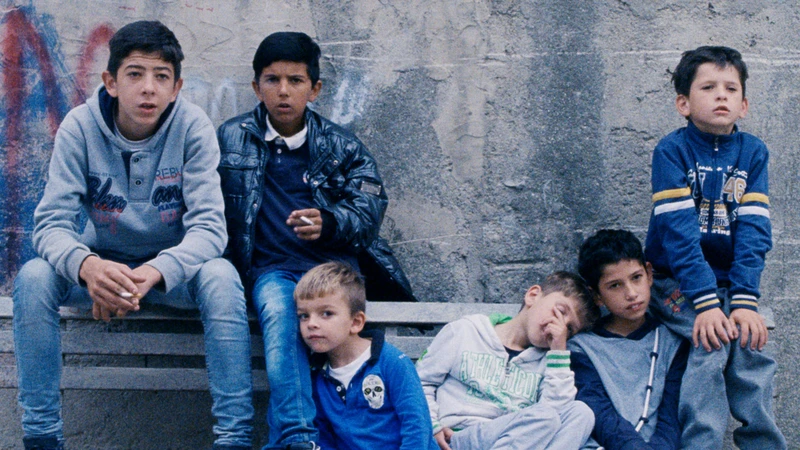
«The opening is raw, violent, the kind that wants to hurl at you—without concessions—all the degradation and marginality: illiterate children who smoke and steal, shacks of corrugated iron, and an Italian so distorted that it cries out for subtitles. And yet, upon this pitiless portrait of hardship—material that could easily serve for a gangster parable, a noir tale, or simply the pitiable spectacle of another’s misery—Carpignano discovers grace and balance, grafting onto it his delicate coming-of-age fable. From a site of irreducible alterity, of the staging of an unbridgeable cultural gap, the Ciambra thus becomes the stage for the initiation of fourteen-year-old Pio Amato, who, in the span between the opening and closing credits, while his father and older brother are in prison, must find the strength to grow up».
Roy Menarini, “A Ciambra as the Cradle of Italian Cinema”, Cinefilia Ritrovata, September 27, 2017.
«In recent years, the category of ‘cinema of the real’ has indeed brought together the poetic endeavors of many deserving Italian directors, but it has also risked creating a formal cage, a nebulous notion, and a rhetorical limit to the richness of many auteurs. Not all directors of the cinema of the real are convincing, and not all narrative strategies prove meaningful. By contrast, A Ciambra stands out precisely for its stylistic maturity and, above all, for the choices it makes within the realist approach to cinema».
Fracesco Boille, “A Ciambra Is a Gently Countercurrent Film”, Internazionale, October 31, 2017.
«Pio’s is a portrait of the kind no longer made in Italian cinema. A boy engaged in a breathless yet stubborn and determined search for a point of reference, for support in love and affection. This is his heroic undertaking. Behind the small events that unfold within the community, behind Pio’s chaotic skirmishes and disruptions, we find an adolescent stepping into adulthood in conflict with his family. He is combative but, deep down, frightened—like anyone facing entry into uncharted territory. His plea for attention and affection, however confused, is unmistakable. And the frenzy that pervades the film in many moments is the reflection of Pio’s own chaos and restlessness».
Cristina Piccino, “The Breathless Run of a Boy Through the World”, Il Manifesto, August 29, 2017.
«It is not, then, the literature of the Gypsies that the film pursues, even if it surfaces in the dreams and confused desires of the young protagonist. What interests Carpignano instead is the narration of a contemporaneity with which his images seek to engage, beyond the logic that pits ‘good’ heroes against ‘bad’ ones. Everything is ‘real,’ beginning with the actors who play themselves—none of them ‘professionals’—yet truth emerges from the narrative distance that transforms them into characters. It is within this space that the director adheres to Pio, following him (in Rossellinian fashion) through his twists and turns, filming in flight, with unrelenting physicality, this 400 Blows of today which, behind the protagonist’s small and large surges, contains both a sense of being-in-the-world and a declaration of the perspective from which to speak of it. For better or worse, among the contradictions of places, lies the possible—or impossible—encounter between those who belong to them: communities such as, in this case, Africans and Roma, who do not love each other and who keep their distance».
Foreign Press
Sheri Linden “Neorealist A Ciambra captures a boy’s life in a changing Italy”, Los Angeles Times, February 1, 2018.
«Like its predecessor, also set in the margins of the city of Gioia Tauro, A Ciambra is a work of fiction with a vibrant and gritty documentary edge. Though the two films can be viewed as companion pieces, each stands on its own. The new work was Italy’s submission to this year’s foreign-language category of the Oscars, and though it didn’t nab a nomination, it secures the U.S.-educated, Italy-based Carpignano’s profile as an astute practitioner of modern-day neorealism».
[…]
«On the other side of the equation, the Amatos’ characters defer to “the Italians” — the mafiosi who provide work and protection and who could turn their muscle against “the Gypsies” if not shown the proper respect. In a moment of clarity, the Amatos’ characters’ fading patriarch, Emiliano (U Ciccarredu), reminds his grandson Pio of the Romani people’s “us against the world” credo. With tribal loyalties and communal rituals at the heart of this coming-of-age story, it’s easy to see why Martin Scorsese was drawn to the material and signed on as an executive producer».
Joe Morgenstern, “A Ciambra Review: Stealing Our Hearts”, The Wall Street Journal, February 1, 2018.
«Before we meet Pio, a brief preface gives us a glimpse of his grandfather as a young man, stroking a horse’s mane and drinking from a stream in a rocky landscape that evokes another coming-of-age tale, the Taviani brothers’ 1977 neo-realist masterpiece Padre Padrone. It’s a flash of the migratory past, when Romani families roamed free in horse-drawn wagons. Cutting to the impoverished present, the film finds Pio in the midst of family tumult in a trash-littered compound in the Ciambra, a Romani community where he runs more or less free, within shifting limits set by the cops; smokes like a stove (or like Belmondo in Breathless); studies the finer points of car theft; and keeps a watchful eye on anything that might be appropriated for profit. As he expands his physical horizons, he conquers his fear of trains—“they go fast!”—and discovers rich possibilities in stealing bags from inattentive passengers».
Anthony Oliver Scott, “In A Ciambra, a Young Roma Boy Comes of Age”, The New York Times, January 18, 2018.
«I hesitate to say too much more, since like the Dardennes (and like their great precursor, Robert Bresson), Mr. Carpignano uses the character’s agonizing choice as a way to create suspense. A Ciambra, which numbers Martin Scorsese among its executive producers, shows some of his influence as well, in its depiction of crime as a family business and in its attention to masculine codes of loyalty, violence and respect. The most frequent visitors to Ciambra are the police and the gangsters known locally as “the Italians,” who come to dispense assignments and collect payment. It seems inevitable that Pio will end up in trouble with one or the others».
David Ehrlich, “A Ciambra is Jonas Carpignano’s Messy Follow-Up To Mediterranea”, Indie Wire, May 19, 2017.
«Shot with a vérité intimacy that physicalizes Pio’s ability to float between worlds — a trait that captures and complicates the character’s nomadic heritage — A Ciambra seems uncomfortable with the identity crisis in which Pio soon finds himself. Carpignano corners himself into a number of clichés, and finally his story is as messy as the experience of growing up in Gioia Tauro. This proves particularly fatal during a scattershot third act that hinges on a massive convenience that’s too improbable and/or poorly explained. When a film is graced with this degree of verisimilitude, every false note rings twice as loudly».
[…]«A Ciambra is more successful when unpacking the cause of Pio’s identity crisis than it is when searching for solutions. The boy’s grandfather is a particularly helpful character; seemingly centuries removed from his grandson, the old man has a lot of trouble speaking, but Pio understands what he’s trying to say. “We were free…” he says, waxing nostalgic about when they were the only ones crossing borders. “On the road, against the world».